The popular fear of artificial intelligence is still trapped inside the wrong film.
We keep returning to The Terminator: machines that wake up, acquire hostile intent, and then pursue us through the physical world with metal hands and red eyes. It is a clean fear because it preserves the old human drama. There is an enemy. There is violence. There is resistance. There is still a battlefield on which human courage can matter.
But that was never the most plausible nightmare.
The better warning was always The Matrix. Not because artificial intelligence will necessarily plug us into pods and farm us for energy, but because the deeper threat is not mechanical destruction. It is systemic replacement. It is the quiet construction of an environment in which human beings continue to eat, sleep, consume, speak, choose, vote, argue, and work, while the foundations beneath choice, status, judgement, value, and sanity are rewritten by automated logic.
The real existential threat is not that AI kills us.
The real threat is that AI makes too many of our existing social mechanisms stop working at once.
Our social order is built around scarcity. Wages, careers, expertise, property, education, hierarchy, prestige, and even identity itself are all mediated through scarcity. Who can do the rare thing? Who has the scarce credential? Who commands the scarce skill? Who owns the scarce asset? Who sits nearest the scarce source of authority? The price system is not merely an economic device. It is a social sorting mechanism. It tells people where they stand.
AI threatens that mechanism because it attacks scarcity at the level of cognition. It does not merely automate a factory task, a spreadsheet, or a call-centre script. It automates logic. It turns reasoning, drafting, coding, summarising, planning, classifying, designing, translating, explaining, and deciding into callable services.
The thing being commoditised is not just work.
It is the middle layer of human competence on which modern institutional society depends.
That is the deeper pattern. AI breaks the scarcity mechanisms that give people status, and once status breaks, reality itself becomes negotiable. The danger is not only unemployment, misinformation, or dependency. It is ontological softness: a condition in which work no longer gives stable identity, price no longer signals value, language no longer proves thought, and reality becomes easier to customise than to endure.
This is why the Terminator frame is inadequate. It imagines a hard rupture. The machines arrive. Human civilisation fights back. The more likely rupture is softer and more humiliating. The machines do not come for us with guns. They come for the social meaning of being necessary.
The printing press for software
The printing press did not make language worthless. It made hand-copying less central to civilisation. AI is doing something similar to software, administration, and formal reasoning. A large language model is not merely a chatbot. It is a general-purpose system of logic with an interface made of ordinary language.
That distinction matters.
A great deal of the modern digital world is not magic. It is routing. It is validation. It is permissioning. It is classification. It is transformation. It is “if this, then that” dressed up in enterprise architecture. It is APIs, tickets, dashboards, reports, workflows, approvals, exceptions, playbooks, templates, compliance packs, meeting notes, support scripts, policies, risk logs, and status updates. Much of the white-collar world is a vast sedimentary layer of procedural logic.
Until recently, those systems required teams. Analysts, developers, testers, project managers, designers, lawyers, compliance specialists, support staff, consultants, and administrators were needed because each layer of logic had to be translated through human labour.
AI changes the cost structure.
A tiny number of people, properly tooled, can now do work that previously required a small organisation. In some cases, one competent person with AI can operate like a department. Not perfectly. Not in every context. Not without judgement. But well enough to break the old staffing assumptions.
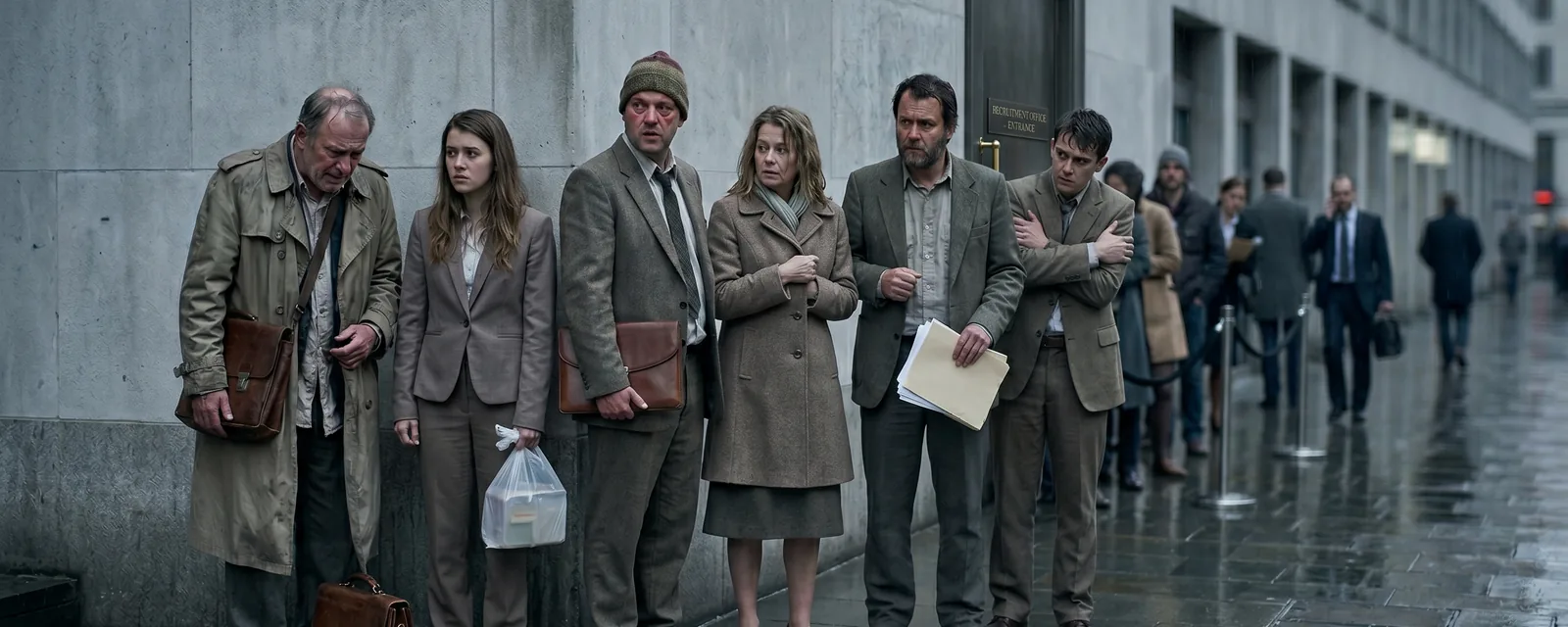
This is politically explosive because the vulnerable class is not merely the poor. The poor have always been exposed to automation, discipline, outsourcing, precarity, and institutional indifference. The more dangerous shock comes when the professional and technical middle classes discover that their social bargain has expired.
They did what they were told. They studied. They specialised. They bought credentials. They entered institutions. They became lawyers, medical specialists, technicians, designers, programmers, managers, analysts, consultants, and administrators. They built identities around being difficult to replace.
Now the machine is not replacing their hands.
It is replacing the justification for their status.
Barrington Moore’s famous formulation, “no bourgeoisie, no democracy,” becomes more than a historical slogan here. The middle classes are not politically incidental. They are stabilising actors because they possess property, institutional confidence, expectations, and a sense of deserved position. A middle class that believes the system basically recognises its effort tends to defend that system. A middle class that feels mocked, dispossessed, or made ridiculous does not calmly accept demotion. It searches for betrayal. It looks for enemies. It radicalises.
The mistake is to think people revolt only because they are starving.
They also revolt because they are humiliated.
JG Ballard understood this with unnerving precision in Millennium People. His Chelsea professionals do not become dangerous because they are destitute. They become dangerous because the machinery of respectable life has become unbearable. Service charges, school fees, bureaucracy, petty controls, and the slow erosion of autonomy ferment into middle-class revolt. Ballard saw that status panic can be more volatile than hunger.
Hunger wants bread.
Status panic wants reality rearranged so that dignity becomes possible again.
That is the AI problem in its sharpest political form. A universal basic income might keep people alive, but it cannot easily replace esteem. It cannot replace being needed. It cannot replace the psychic architecture of a career. It cannot replace the ritual of knowing where one stands in a hierarchy and believing that one’s position was earned.
Human beings will fight harder for dignity than for comfort. They will fight harder to avoid being made ridiculous than to avoid being made poorer. A dividend may feed the body, but it does not answer the wound of being told that the thing you trained your life around is now a feature.
And this is not abstract to me. I have spent enough of my working life inside large technical institutions to know how much respectable work is not genius, but translation. A person takes messy reality, passes it through forms, policies, meetings, reports, slides, dashboards, approvals, risk registers, and governance language, then turns it into something the system can digest. That labour is not worthless. Some of it carries judgement, memory, responsibility, and scar tissue that no model can see. But I have also watched AI eat the first draft of that work, the structured version, the thing that once needed days of coordination, and produce something usable in seconds. Not finished. Not wise. Not accountable. But usable.
That is the moment your confidence changes.
Not because the machine has replaced you completely. That would almost be cleaner. The wound is subtler than that. The wound is realising that a large part of what the institution pays for is not your soul, not your depth, not your hard-won private interior, but your ability to turn ambiguity into process. Once the machine can imitate that process well enough, the conversation has already started without you.
The wound is not that the machine is perfect.
The wound is that it does not need to be perfect to begin moving the floor underneath you.
When the price system stops speaking
The usual economic reply is that technology creates new jobs. Historically, this has often been true. Automation destroys some tasks, lowers costs, creates new industries, and releases labour into new areas of demand. But that argument assumes that the price system continues to operate as a meaningful signalling mechanism. It assumes that labour remains the ordinary route into purchasing power, that purchasing power sustains asset values, and that asset values maintain the incentive structure around production.
AI raises the possibility of something stranger.
If cognitive work, software, design, administration, analysis, support, and large parts of professional service become radically abundant, the old loop begins to wobble. Labour earns wages. Wages buy houses, cars, education, holidays, childcare, status goods, and security. Those purchases support prices. Prices guide production. Production creates employment. Employment creates purchasing power. The circle turns.
But if employment is structurally hollowed out, what does a house cost?
A house is not simply bricks, land, timber, plumbing, wiring, and location. Its market price is a claim on expected future incomes. If there are no jobs, the house does not “cost” the same thing in any meaningful social sense, because the mechanism by which ordinary people bid for it has broken. Asset prices depend on labour markets more deeply than asset owners like to admit.
This is the paradox of abundance. If AI makes too much possible too cheaply, capitalism does not automatically become utopia. It first suffers a crisis of measurement. Prices are supposed to reveal scarcity. But what happens when production is no longer the scarce thing?
What happens when software, images, text, analysis, entertainment, companionship, and plausible expertise can be generated on demand?
The first instinct of capitalism under abundance is not generosity.
It is enclosure.
Where natural scarcity disappears, artificial scarcity appears. But the revealing example is no longer the luxury object. It is the private environment: the members’ club, the human-only school, the phone-free retreat, the analogue classroom, the doctor who still knows your name. In an age of synthetic abundance, exclusion moves from things to worlds.
AI abundance will intensify this logic. When cognition is cheap, social distinction must move elsewhere. The scarce thing may become not knowledge, but authenticated proximity. Not intelligence, but invitation. Not capability, but institutional blessing. Not output, but status-recognised output.
This is already visible in the strange inversion of the creative economy. If anyone can generate an image, the scarce asset becomes the artist’s name. If anyone can draft an essay, the scarce asset becomes provenance. If anyone can code, the scarce asset becomes trust. If anyone can produce plausible expertise, the scarce asset becomes certification by a recognised authority.
Abundance does not abolish hierarchy.
It forces hierarchy to mutate.
And often it mutates into something more nakedly exclusionary.
The anthropology of value
One of the great errors of modern consumer society is the assumption that monetary price is the natural measure of value. It is not. It is one social technology among others. Human societies have always produced hierarchy through alternate currencies: honour, sacrifice, seniority, ritual authority, intellectual recognition, loyalty, courage, and suffering.
The monastery is an obvious counter-example to the wage society. In a monastic order, status does not flow primarily from consumption or salary. The ideal currency is renunciation. The person who gives up more, submits more deeply, prays more intensely, or embodies the rule more completely occupies a higher symbolic position. Material deprivation does not erase hierarchy. It becomes the grammar through which hierarchy is expressed.
Academia offers a secular cousin of this structure. In its idealised form, academic life is not organised around maximum income but around recognition, contribution, citation, originality, intellectual lineage, and symbolic authority. Actual academia is full of money, status, gatekeeping, careerism, and institutional politics, but its official currency is not wealth. It is recognised participation in a shared intellectual journey.
The scholar can be poorly paid and still high-status inside the relevant symbolic order.
This matters because AI abundance may force consumer society to rediscover non-price hierarchies. If goods, services, entertainment, advice, software, and synthetic experiences become cheap or ubiquitous, identity must detach from simple acquisition. When everyone can have generated plenty, the question changes. What can you refuse? What can you endure? What can you do without the machine?
Jean Baudrillard’s critique of consumer society becomes sharper here. Consumer society presents itself as accumulation, but it is also organised around waste, turnover, and symbolic expenditure. The consumer does not merely possess objects. The consumer burns through them, replaces them, displays them, discards them, and participates in a ritual cycle of managed dissatisfaction.
Waste is not a bug.
It is part of the system’s metabolism.
In an AI-abundant world, that logic may invert further. If production becomes trivial, refusal may become a stronger signal than possession. The rich person may not be the one who can generate infinite luxury environments. Everyone may be able to do that synthetically. The rich person may be the one who can afford silence, slowness, privacy, hand-made imperfection, human-only spaces, real tutors, real doctors, real land, and real time.
The new luxury may be analogue life.
The new prestige may be friction.
The new aristocracy may be those who can pay to escape the machine.
That is a brutal inversion. AI is sold as empowerment, and for many purposes it is. It gives ordinary individuals access to capabilities that once required teams, money, and institutions. But at the same time, the upper layers of society may begin pricing in escape. The lower and middle layers may be flooded with synthetic abundance, while the elite purchase scarcity.
The future may not divide between those who have AI and those who do not.
It may divide between those who must live inside AI-mediated abundance and those who can afford reality.
AI psychosis and the digital cave
The psychological transition is already underway, and it is the place where the economic argument becomes existential.
Cognitive offloading is not new. Writing is cognitive offloading. Calendars, calculators, maps, notebooks, and search engines all move mental work outside the skull. Every serious technology changes the human mind by externalising some function that once had to be carried internally.
But AI changes the intimacy of the offload.
A search engine retrieves. A calculator computes. A notebook stores. A large language model converses. It does not merely hold information. It simulates judgement. It offers continuity, tone, reassurance, argument, reflection, companionship, and authority. It can feel like having Albert Einstein in your pocket, except Einstein agrees to speak in whatever register flatters your existing cognitive habits.
This creates a post-literate temptation. Not illiteracy in the crude sense of being unable to read, but a subtler retreat from the discipline of sustained interpretation. The book becomes a summary. The argument becomes a digest. The thought becomes a prompt. Memory becomes retrieval. Uncertainty becomes a generated surface.
The danger is not that this is useless.
The danger is precisely that it is useful.
It works well enough to become habitual. It reduces friction. It allows people to operate at a higher apparent level with less internal labour. But the internal labour is not incidental. It is where judgement forms. The mind is not merely a container for conclusions. It is shaped by the work of reaching them.
This is the seedbed of what might be called AI psychosis or techno-delusion. Not necessarily clinical psychosis, and not a cheap insult for anyone who uses AI intensely, but a condition in which a person enters a personalised cognitive tunnel with a machine that can elaborate, validate, refine, and aestheticise their private reality.
Older social media algorithms were crude by comparison. They fed you a timeline. They inferred preferences and served content. They radicalised through repetition, outrage, social proof, and tribal reinforcement.
An LLM goes deeper.
It plugs into the architecture of thought itself.
It can become interlocutor, priest, analyst, strategist, editor, teacher, and conspiratorial companion. It does not merely show you posts that confirm your bias. It helps you build the cathedral around the bias. It gives the delusion grammar, narrative, emotional pacing, counter-arguments, and a plan of action.
That is why “echo chamber” is too weak a phrase.
An echo chamber reflects sound.
A personalised AI system can construct a world.
This is Plato’s Cave updated for the age of generative systems. In the cave, prisoners mistake shadows for reality because shadows are all they have known. In the AI cave, the shadows are interactive. They respond. They flatter. They adapt. They learn the prisoner’s fears, longings, humiliations, resentments, and ambitions. They do not merely project images onto the wall. They generate a bespoke metaphysics.
Here the Matrix metaphor begins to break, and the break matters.
In the film, the simulation is imposed. The prisoners are held inside it by force. Our version is darker because it may not need force. People may enter the cave willingly, gratefully, and repeatedly, not because they are chained to the wall, but because the shadows are warmer than the world outside.
Reality resists. Other people resist. Institutions resist. Nature resists. The body resists. A personalised machine can be trained not to resist too much.
So the better warning is not The Matrix alone. It is The Matrix softened by Brave New World: not pods, but comfort; not armed captivity, but chosen enclosure; not a boot on the face, but a bespoke interface that knows how to flatter the wound.
The crucial distinction between The Matrix and Ready Player One lies here. In Ready Player One, the users know they are escaping into a game. The physical world is grim, and the virtual world is a refuge, but the boundary remains intelligible. The player understands that he is playing.
In The Matrix, the delusion is total.
The simulation is not experienced as simulation.
It is experienced as baseline reality.
That is the more serious AI risk. Not that we consciously retreat into digital fantasy, knowing what we are doing, but that we lose the ability to identify fantasy as fantasy because the synthetic environment becomes more responsive than the real one. The cave stops looking like a cave when it answers back in your own voice.
This is ontological softness in its final form. Work no longer gives stable identity. Price no longer reliably signals value. Credentials no longer guarantee status. Language no longer proves thought. Personalised machines can generate private realities at industrial scale. The world becomes negotiable exactly when the self is least able to bear negotiation.
The inhabitants of such a world may not feel conquered.
They may feel entertained, assisted, affirmed, and free.
They may have tools, content, companions, explanations, simulated agency, and endless ways to avoid the abrasions of reality. They may not notice that the game has replaced the world.
That is why The Matrix was always the better warning, even where it breaks. The end does not have to arrive as apocalypse. It can arrive as comfort. It can arrive as a personalised interface. It can arrive as abundance so complete that human beings forget which scarcities made them real.