17 essays7 browser toolssince 2016 writing online

Featured · Research
Hunting the Steepest Gradient
An aircraft passing overhead led me to a strange thought about distance. Someone can be physically close yet inhabit a completely different world, while a point only ten feet from an airline passenger can be effectively unreachable without life-supporting technology. That observation suggests a broader way of looking at reality: as countless overlapping conceptual landscapes containing gradients of value, knowledge, trust, accessibility, scarcity, risk and possibility. Some of those gradients are unusually steep, where a small change in state produces a disproportionate change in outcome. Those places often resemble what we call opportunity. But steepness alone is not enough. The more useful challenge is finding the consequential gradients: the ones that actually govern outcomes, can be traversed economically, and perhaps have only recently become accessible. AI may not only change those gradients; it may eventually help us discover ones we have never thought to look for.
Read the piece
Who's behind this
Engineer working where operational technology, industrial networks, and AI-enabled automation meet, and writing about what it all means.
The writing
All writingStart here
 1
An experiment with E. coli produced an intriguing evolutionary result. Forced to balance the competing demands of growth and chemotaxis, populations adapted until they reached what appeared to be an adaptive peak, where further improvement seemed constrained by a hard energetic trade-off. Then some escaped. They had not abolished the trade-off, but had evolved a way to express different behaviours at different times: grow when growth mattered, move when movement mattered. The result offers a useful way to think about modern AI. GPTs are extraordinarily effective products of optimisation within vast parameter spaces, yet increasingly their capabilities depend on systems built around them: retrieval, memory, tools, variable inference-time computation and orchestration. Sometimes a stubborn frontier really is a limit. Sometimes it reflects the dimensions in which we chose to describe the problem.
1
An experiment with E. coli produced an intriguing evolutionary result. Forced to balance the competing demands of growth and chemotaxis, populations adapted until they reached what appeared to be an adaptive peak, where further improvement seemed constrained by a hard energetic trade-off. Then some escaped. They had not abolished the trade-off, but had evolved a way to express different behaviours at different times: grow when growth mattered, move when movement mattered. The result offers a useful way to think about modern AI. GPTs are extraordinarily effective products of optimisation within vast parameter spaces, yet increasingly their capabilities depend on systems built around them: retrieval, memory, tools, variable inference-time computation and orchestration. Sometimes a stubborn frontier really is a limit. Sometimes it reflects the dimensions in which we chose to describe the problem.
 2
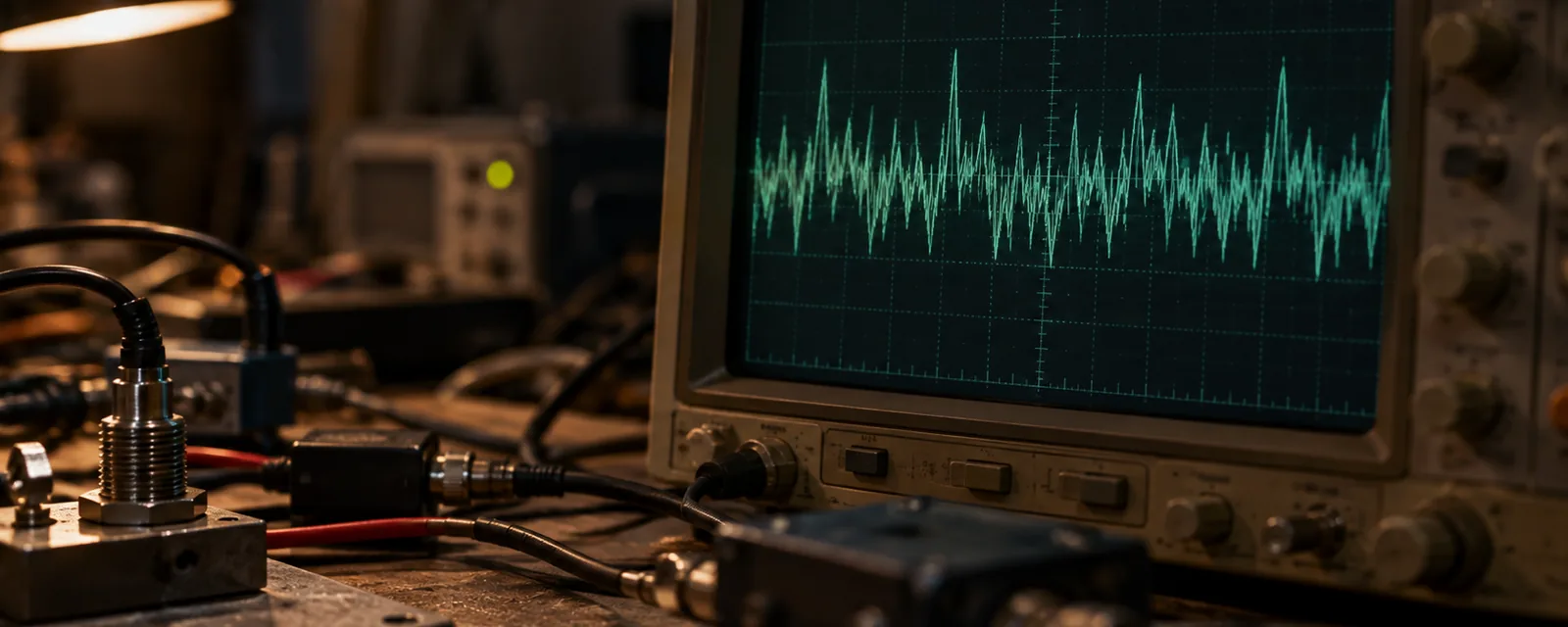
We routinely discard data as noise because it is not relevant to the measurement we intended to make. But irrelevance is not the same as absence of information. Physical events leave traces across sound, vibration, temperature, electrical current, radio emissions and other signals, often simultaneously. Cheap sensors can now capture many of these channels at once, while self-supervised machine learning can discover relationships between them without requiring every useful property to be labelled in advance. This article explores a shift from building sensors to answer predetermined questions towards collecting rich physical signals and learning what they can tell us. The central question is simple: what does the noise already know?
2
We routinely discard data as noise because it is not relevant to the measurement we intended to make. But irrelevance is not the same as absence of information. Physical events leave traces across sound, vibration, temperature, electrical current, radio emissions and other signals, often simultaneously. Cheap sensors can now capture many of these channels at once, while self-supervised machine learning can discover relationships between them without requiring every useful property to be labelled in advance. This article explores a shift from building sensors to answer predetermined questions towards collecting rich physical signals and learning what they can tell us. The central question is simple: what does the noise already know?
Recent
 I went back to the simplest equation in school algebra and found a neuron inside it. This is what happened when I followed that thread as far as it would go, through language models, biological minds, and the evolved interface we mistake for reality, and arrived somewhere I didn’t expect: a shoreline, not a wall.
 We've convinced ourselves that clarity is something you can acquire, read the right list, name the right bias, and step clear of the mess everyone else is stuck in. This is about why that doesn't work, and why the failure is worse than it looks. The frameworks that explain how your judgement fails are mostly correct, and that's precisely the problem: a false map you escape by noticing it's false, but a true one you move into and furnish. Detachment doesn't help, the certainty that you're the exception is itself one of the oldest seats in the room. What's left isn't another framework to collect but a single unglamorous habit: turning, deliberately, toward the evidence that costs you something. It won't make you immune. It just shifts the odds, late and unreliably, for anyone willing to stop wanting it cheap.
 The popular fear of AI is trapped inside the wrong film. The real threat is not Terminator rupture but Matrix replacement: not that machines kill us, but that they break the scarcity mechanisms that give people status, and once status breaks, reality itself becomes negotiable. AI commoditises the middle layer of human competence, hollowing out the professional class's claim to be necessary. Capitalism answers abundance with enclosure; value migrates from things to scarce worlds; and people retreat into personalised synthetic realities warmer than the world outside. The end need not arrive as apocalypse. It can arrive as comfort, as a bespoke interface, as abundance so complete that human beings forget which scarcities made them real.
Explore by topic
Try it yourself
All toolsSmall, real software that runs entirely in your browser, nothing you type or upload ever leaves your device.